

Bridging Reason and Reality: DataWalk’s Unique Hybrid Graph Reasoning for Enterprise AI
Bridging Reason and Reality: DataWalk’s Unique Hybrid Graph Reasoning for Enterprise AI
Key Takeaways
- The Reasoning Imperative: Agentic AI systems require explicit multi-hop context and fact-grounding to plan, evaluate evidence, and prevent hallucinations in complex enterprise scenarios.
- Reasoning vs. Inference: Reasoning is the structural design of rules and logic (e.g., UBO propagation formulas), whereas inference is the computational execution that materializes new facts and lineage.
- Hybrid Operational Ontology: DataWalk combines the high-speed traversal of Labeled Property Graphs (LPG) with the semantic richness of RDF through a decoupled ontology layer.
- Eager Inference via Graph Consistency: Derived facts are calculated, stored, and automatically refreshed upon data changes—even handling partial or asynchronous data arrival smoothly.
Introduction: Why Reasoning Matters for AI and Agentic Systems
Modern artificial intelligence systems are no longer confined to basic pattern recognition. Agentic AI—systems capable of autonomous planning, adaptation, and execution—must comprehend deep operational context, evaluate evidence, and justify decisions. While Large Language Models (LLMs) excel at broad semantic understanding, they consistently struggle with multi-hop reasoning, precise fact retrieval, and navigating complex enterprise data relationships.
Knowledge graphs bridge this operational gap by providing a machine-readable network of entities, relationships, and context. They enable explicit reasoning from high-level rules to concrete conclusions. For agentic AI, this capability is critical when investigating supply chain vulnerabilities, detecting high-risk counterparties, or aligning AI actions with regulatory policies.
Inference—the process of deriving new facts from existing data—ensures AI systems answer not only explicit queries, but also expose implicit, high-value insights. DataWalk’s hybrid graph analytics platform delivers enterprise-grade reasoning and inference engineered specifically for mission-critical AI applications.
Reasoning vs. Inference
Reasoning is the general process of drawing conclusions from existing knowledge using deductive, inductive, or abductive logic. Inference refers specifically to computing and materializing new facts by executing defined logical rules against explicit data. In practice, reasoning is the design of the logic, while inference is the execution of that logic to generate output data.
Practical Example: Ultimate Beneficial Ownership (UBO)
- Reasoning (Logic Design): Ownership propagates through corporate shareholding. Multiply percentages sequentially along each path, then aggregate over all disjoint paths. A UBO is detected when cumulative indirect ownership meets or exceeds a 25% threshold.
- Inference (Engine Execution): The graph engine calculates that Entity A owns 80% of Entity B, and Entity B owns 40% of Entity C. The derived ownership of A in C is 32%. Because 32% ≥ 25%, Entity A is automatically flagged as a UBO and written to the database alongside its full data lineage.
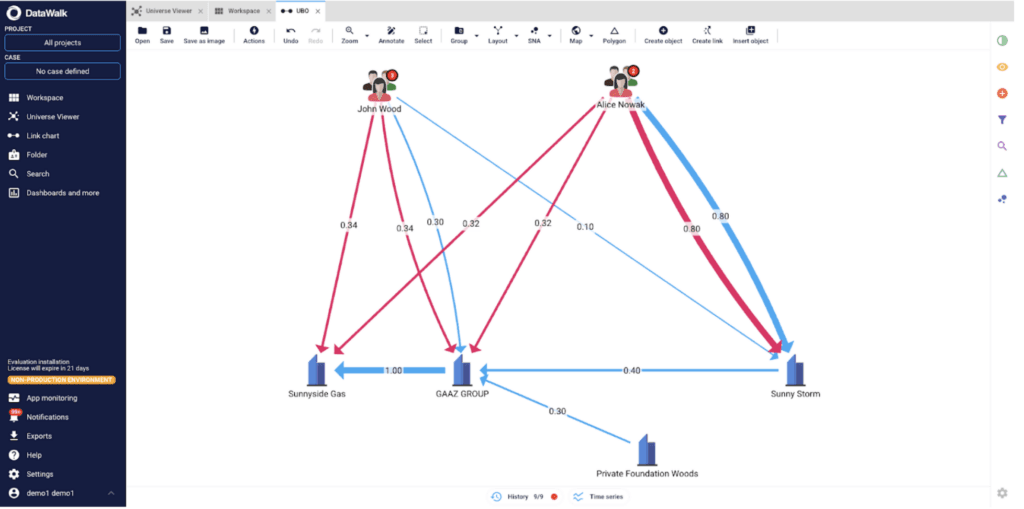
As illustrated in Figure 1, evaluating an entity’s complete ownership structure requires analyzing direct links and computing indirect shareholding paths. Because Alice holds an 80% direct stake in Sunny Storm, inference algorithms automatically establish her indirect 32% ownership in both GAAZ Group and Sunnyside Gas.
Graph Models and Reasoning: RDF vs. Property Graphs
Semantic Knowledge Graphs (RDF)
Resource Description Framework (RDF) structures data as atomic triples (subject–predicate–object). Combined with the Web Ontology Language (OWL), RDF enables rich class hierarchies, formal axioms, and automated ontology-based inference. However, RDF triple stores are inherently verbose and inefficient for deep path traversals. Storing metadata requires additional triples, increasing storage overhead and degrading query performance at scale.
Property-Graph Databases (LPG)
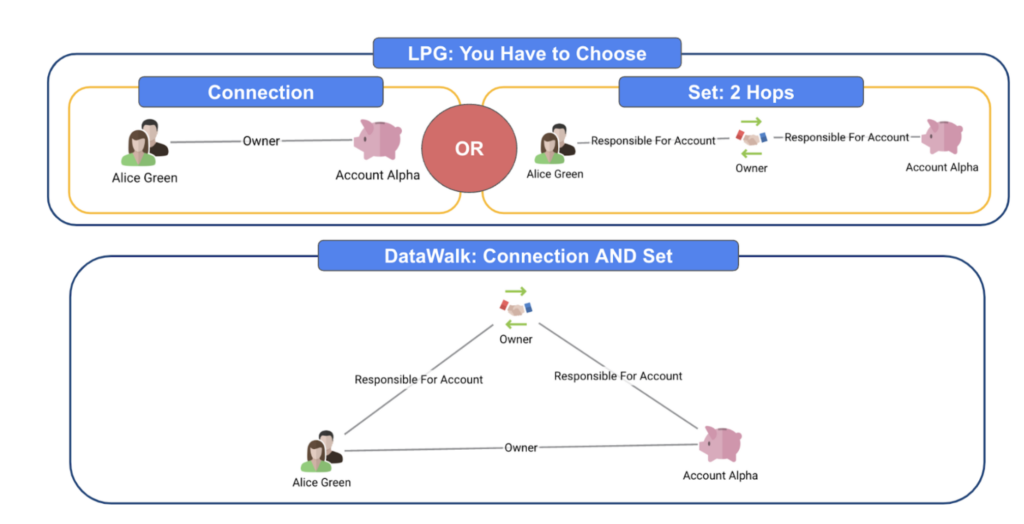
Labeled Property Graphs (LPGs) optimize deep graph traversals by storing data as nodes and edges with attached key-value properties. Platforms like Neo4j and TigerGraph excel at high-speed graph traversals, but they prioritize speed over strict semantic schemas. LPGs lack native reasoning mechanisms such as class inheritance or transitive property propagation, forcing developers to write custom procedural code or rely on external extensions.
Performance Trade-Offs
LPGs lack native, declarative inference. Running inference across massive property graphs requires scanning and recomputing complex traversals continuously, leading to severe operational bottlenecks. While traditional graph databases handle static connected data well, they frequently struggle under real-time multi-hop traversal workloads.
How Ally Built a Modern Fraud Intelligence Platform
Learn how Ally applied graph analytics and contextual investigation tools to uncover complex fraud networks and strengthen fraud prevention.
Read Case Study
DataWalk: A Hybrid Knowledge Graph Architecture
DataWalk bridges the divide between RDF semantics and LPG performance using a hybrid operational ontology architecture. This design stores underlying data in a high-performance graph engine while maintaining an independent ontology layer that defines entities, attributes, and logical rules. This enables dynamic inference, multi-hop traversals, and semantic enrichment without sacrificing query velocity.
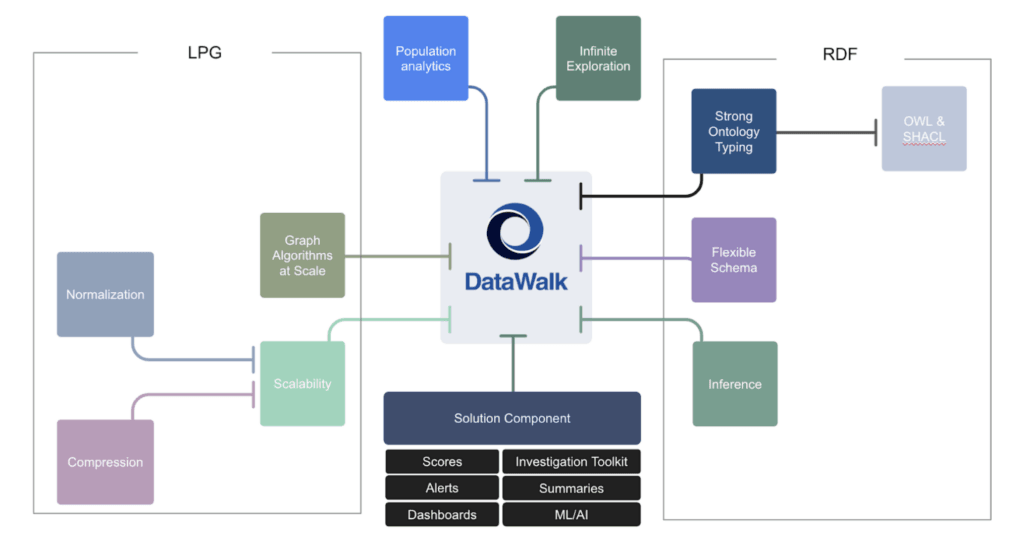
Instead of relying on rigid RDF triples or basic edge properties, DataWalk introduces Connecting Sets: first-class relationship objects. Connecting Sets behave as direct edges for rapid traversal, while simultaneously acting as fully attributed nodes capable of holding metadata, maintaining audit logs, and linking to other connections.
The Graph Consistency Engine
At the core of DataWalk’s inferencing capability is the Graph Consistency Engine (dependency refresh engine). Whenever data is ingested or modified, this engine automatically evaluates logical rules and materializes derived facts back into the operational graph.
DataWalk implements eager inference: derived facts are persisted directly as first-class entities in the database and automatically refreshed as underlying dependencies change. Non-materialized, on-demand inference is also supported for specialized workloads.
Crucially, the Graph Consistency Engine does not require both sides of a relationship to be present simultaneously. It calculates partial inferences when initial conditions are met, holding intermediate states in the graph. When missing data arrives—days or months later—the system automatically resolves the rule, updating all downstream analytics.
Rule Palette Components
| Component | Purpose | Operational Example |
|---|---|---|
| Autoconnects | Establishes relationships automatically based on matching attributes across sets. | Generates an “ownership” link when two entities share a tax identifier or shareholding threshold. |
| Virtual Paths | Defines indirect multi-hop relationships without duplicating raw data. | Inherits risk scores across multi-tier corporate shareholding chains. |
| Calculated Columns | Computes dynamic values using SQL-like expressions and logic. | Calculates cumulative indirect ownership or aggregates transaction risk scores. |
| Analyses | Persists complex multi-entity query structures and updates results dynamically. | Identifies community clusters or tracks transaction counts within three hops. |
| Scoring Engines | Assigns composite risk or confidence scores based on rules and model outputs. | Generates a real-time risk index by aggregating anomaly indicators from connected nodes. |
| App Center Apps | Executes advanced custom Python algorithms directly within the environment. | Integrates external ML models, Graph Neural Networks (GNNs), or NLP pipelines. |
Implementing Semantic Web Inference Rules in DataWalk
DataWalk supports a focused subset of semantic web inference rules optimized for operational intelligence:
| Semantic Rule | Logic Description | DataWalk Materialization Method |
|---|---|---|
| Functional Property | A property has a unique value per subject (e.g., an employee has one direct supervisor). | Enforced via Autoconnects and Calculated Columns; conflicting values trigger alerts. |
| Inverse Functional Property | Shared property values imply identity resolution (e.g., matching tax IDs indicate the same entity). | Autoconnects automatically merge or link records during entity resolution workflows. |
| Inverse Property | Property P implies inverse property Q (e.g., Parent of $\rightarrow$ Child of). | Reciprocal links are created automatically and maintained by the Graph Consistency Engine. |
| Symmetric Property | Relationship holds bi-directionally (e.g., Partner of $\leftrightarrow$ Partner of). | Materializes bi-directional links automatically across corporate or peer networks. |
| Transitive Property | If A $\rightarrow$ B and B $\rightarrow$ C, then A $\rightarrow$ C (e.g., ownership chains). | Virtual Paths compute transitive closures across multi-hop corporate structures. |
Enterprise Deployment Considerations
- Operational Inference Focus: DataWalk prioritizes deterministic, explainable operational inference over abstract description logic. All materialized facts maintain explicit data lineage that analysts can inspect and validate.
- Scalability & Deep Traversal: By materializing derived relationships and leveraging parallel processing in the Graph Consistency Engine, DataWalk executes deep recursive queries without the latency spikes common in conventional LPG databases.
- Composite AI Integration: Inference operates as a core component of DataWalk’s Composite AI strategy—combining rule-based logic, graph analytics, machine learning, and agentic workflows into a single operational interface.
Conclusions: Connected Data to Connected Knowledge
Knowledge graphs are fundamental to enterprise AI systems requiring reasoning, explainability, and multi-hop context. DataWalk’s hybrid operational knowledge graph unites the speed of property graphs with an ontology-driven Graph Consistency Engine. By materializing inferences at scale while maintaining sub-second performance, DataWalk enables organizations to deploy explainable, adaptable, and trustworthy AI systems.
How DataWalk AI is Transforming Investigative and Intelligence Analytics
Download the eBookFAQ
What is the difference between reasoning and inference in knowledge graphs?
Reasoning is the structural design of logical rules and axioms used to draw conclusions from data. Inference is the computational execution of those rules to calculate, materialize, and persist new facts within the graph.
How does DataWalk’s hybrid architecture differ from traditional RDF and LPG databases?
DataWalk combines the high-speed multi-hop traversal performance of Labeled Property Graphs (LPG) with the formal semantic modeling and inference capabilities of RDF. It uses a property-graph storage engine paired with an independent ontology layer, avoiding RDF query verbosity while providing native reasoning missing in standard LPGs.
What is the role of the Graph Consistency Engine in DataWalk?
The Graph Consistency Engine automatically evaluates inference rules when data is added or modified. It materializes derived facts directly into the graph and maintains them dynamically. It also handles partial inferences, completing calculations automatically when missing data arrives over time.
What are Connecting Sets in DataWalk?
Connecting Sets are first-class relationship objects in DataWalk. They function as fast direct edges for traversal while simultaneously acting as fully attributed nodes that can hold properties, store audit logs, and connect to other relationships (“links to links”).
How does DataWalk support semantic web rules like transitivity?
DataWalk materializes transitive properties (such as multi-tier corporate ownership chains) using Virtual Paths and Autoconnects. The Graph Consistency Engine automatically computes and updates these transitive closures across multi-hop networks.
How does DataWalk ensure explainability for AI-driven inferences?
DataWalk stores inferred facts directly in the graph as first-class objects linked to their underlying data lineage. Investigators and analysts can trace every derived relationship back to the exact rule, source data, and operational logic that created it.
DataWalk Platform
See DataWalk in action
Request a personalised live demo and discover how DataWalk connects the dots across your data.